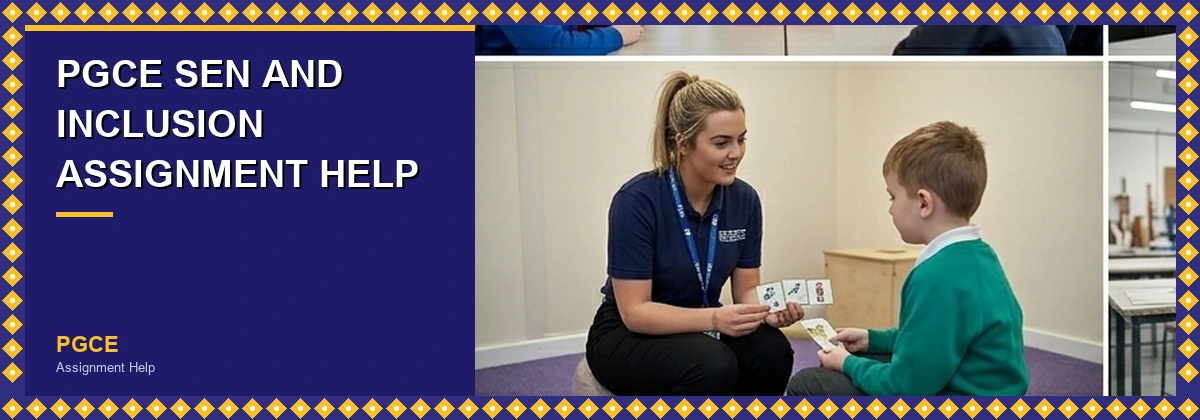
What Does a PGCE SEND or Inclusion Assignment Require?
A PGCE SEND and inclusion assignment requires the trainee to write academically about Special Educational Needs and Disabilities (SEND), inclusive pedagogy, and differentiation — connecting classroom practice to legislation, disability theory, and evidence-based inclusion strategies. At Level 7, this means critically engaging with the SEND Code of Practice (DfE & DoH, 2015), the Equality Act 2010, and inclusion theory, rather than describing provision in general terms.
Across all PGCE routes — [Primary](/pgce-primary-assignment-help/), [Secondary](/pgce-secondary-assignment-help/), and [Further Education](/pgce-further-education-assignment-help/) — inclusion assignments connect to TS5 (Adapt teaching to respond to the strengths and needs of all pupils), which explicitly references SEND, EAL, and disadvantaged learners. Most providers also require TS1 (high expectations for all) and TS4 (well-structured lesson planning with differentiation embedded) to be evidenced. Some providers explicitly require engagement with the Equality Act 2010 and its relevance to reasonable adjustments in classroom practice.
Common assignment formats: a case study of a specific learner with identified SEND needs, analysed through the frameworks of the Code of Practice and inclusion theory; a critical evaluation of differentiation strategies used in placement, referenced to Vygotsky, Bruner, and UDL principles; a position essay on inclusive versus segregated provision in mainstream schools. Word count is typically 2,500–4,000 words.
SEND Code of Practice 2015 in PGCE Assignments: What to Reference and How
The SEND Code of Practice: 0 to 25 years (DfE & DoH, 2015) is the statutory guidance for local authorities, schools, and education providers in England regarding SEND identification, assessment, and provision. All PGCE trainees are expected to know and apply its key principles. For written assignments, the Code of Practice provides both a legal framework and a professional reference point — but assignments must engage with it analytically, not merely cite it as a list of definitions.
Key elements of the Code of Practice relevant to PGCE assignments: the four broad categories of SEND (Communication and Interaction; Cognition and Learning; Social, Emotional, and Mental Health; Sensory and/or Physical); the graduated approach (Assess, Plan, Do, Review cycle); the role of the SENCO (Special Educational Needs Coordinator); Education, Health and Care Plans (EHCPs); and the principle of the least restrictive environment — that learners with SEND should be supported in mainstream provision wherever possible.
Citation format: DfE and DoH (2015) SEND Code of Practice: 0 to 25 years. London: DfE. Reference as (DfE & DoH, 2015) in-text. Do not cite it as "the government" or "Ofsted" — the institutional authors are the Department for Education and Department of Health jointly.
Application in an assignment: "The SEND Code of Practice (DfE & DoH, 2015) places a statutory duty on schools to use a graduated approach — Assess, Plan, Do, Review — when identifying and meeting learner SEND needs. In my placement classroom, three learners were on the SEND register with identified needs in Cognition and Learning. The provision in place (pre-printed word banks and extended time for written tasks) reflected the 'Plan' and 'Do' phases but lacked a structured 'Review' mechanism embedded in lesson cycles — a gap identified by my mentor and relevant to both TS5 (adapt teaching) and the Code's requirement for provision to be responsive rather than static."
Social Model vs Medical Model of Disability in PGCE Inclusion Essays
The distinction between the social model and the medical model of disability is one of the most important conceptual frameworks in PGCE inclusion assignments. Getting this distinction right — and engaging critically with its implications for classroom practice — is what separates Merit and Distinction responses from Pass-level work.
The medical model (also called the deficit model or individual model) locates disability within the individual — it is a condition to be diagnosed, treated, or managed. In educational practice, the medical model leads to provision that focuses on remediation: withdrawal groups, specialist interventions, and individual programmes designed to bring the learner closer to a "normal" standard. The learner is the problem; the curriculum and environment are neutral.
The social model (Oliver, 1990 — The Politics of Disablement; UPIAS, 1976) locates disability in the barriers created by society and the physical and attitudinal environment — not in the individual. A learner who uses a wheelchair is not "disabled" by their wheelchair use; they are disabled by stairs, inaccessible formats, and inflexible routines. In educational practice, the social model leads to provision that modifies the curriculum, the environment, and the teaching to remove barriers — rather than modifying the learner.
For PGCE inclusion assignments: engage with both models and evaluate which framework underpins your placement school's provision. Most school SEND provision operates within a hybrid model — identifying individual needs through the Code of Practice (which uses diagnostic language and categories that reflect the medical model) while aspiring to social model principles of barrier removal and full inclusion. The tension between these two frameworks is analytically productive at Level 7.
Universal Design for Learning (UDL) in PGCE SEND Assignments
Universal Design for Learning (UDL — CAST, 2018; Rose & Meyer, 2002) is a curriculum design framework that builds flexible access into learning from the outset rather than retrofitting accommodations for individual learners. Its three principles are: (1) Multiple Means of Representation (presenting content in varied formats — visual, auditory, textual); (2) Multiple Means of Action and Expression (allowing learners to demonstrate understanding in varied ways — spoken, written, drawn, performed); (3) Multiple Means of Engagement (offering choices and challenge levels that support learner autonomy and motivation).
UDL is the social model's curricular expression — it removes barriers structurally rather than providing individualised fixes. For PGCE inclusion assignments, UDL provides a practical framework for evaluating whether placement lessons were designed with inclusion as a structural feature or as an afterthought. "The literacy task I designed assumed written output as the sole means of demonstrating understanding — a UDL (CAST, 2018) Multiple Means of Expression analysis would identify this as a barrier for learners with dyslexia, motor difficulties, or high anxiety about written performance. An accessible design would have offered a choice of output format before the task — not a modification requested by the learner after encountering the barrier."
UDL connects directly to TS5 in PGCE assignments — adapting teaching to respond to the needs of all pupils. The UDL framework reframes TS5 from reactive differentiation (modifying tasks for individuals who struggle) to proactive design (removing barriers before they are encountered).
Differentiation Theory for PGCE SEND: Vygotsky's ZPD and Scaffolding
Differentiation — adapting teaching to meet the diverse needs of all learners in a mixed group — is the pedagogical expression of TS5 in classroom practice. PGCE inclusion assignments require the trainee to move beyond describing what differentiation strategies were used to theorising why those strategies are effective (or ineffective) for specific learner profiles.
Vygotsky's (1978) Zone of Proximal Development (ZPD) is the primary theoretical framework for differentiation in PGCE assignments. The ZPD identifies the gap between what a learner can do independently and what they can achieve with appropriate support from a more knowledgeable other (MKO). Effective differentiation — scaffolded support that is calibrated to the learner's current ZPD — develops learner competence and then gradually withdraws support as competence grows. Ineffective differentiation either provides too little support (learner cannot access the task) or too much (learner is not required to develop independent competence).
For SEND learners: the ZPD framework requires the teacher to know the learner's current level of independent competence — which requires assessment data, SENCO advice, and ongoing formative monitoring. PGCE assignments that reference Vygotsky in SEND contexts should also acknowledge the limits of the ZPD as a framework: it assumes a clear MKO role, but in mainstream classrooms with 30 learners and one teacher, sustained individual scaffolding is practically constrained.
How to Critically Evaluate Inclusive Practice in Your Classroom
Critical evaluation of inclusive practice in a PGCE assignment requires the trainee to assess whether the strategies used in placement were genuinely inclusive — removing barriers to participation — or superficially inclusive — providing modifications that still positioned learners with SEND as different from the norm.
Questions for critical self-evaluation: Did the differentiation strategy require the learner to identify themselves as needing support (which can increase stigma)? Was the provision consistent across the unit, or applied ad hoc when difficulties became visible? Did the SEND learner have the same cognitive challenge and intellectual engagement as peers, or were they given a simplified version of the task that reduced the opportunity for high-order thinking? Was the provision informed by up-to-date SENCO guidance and the learner's EHC plan, or based on the trainee's assumptions?
An analytically strong critical evaluation: "The word bank provided to Pupil C (identified with dyslexia) was available on request rather than universally available to all learners. This design choice — while reducing administrative burden — required Pupil C to publicly identify their need, potentially increasing the social cost of accessing support (a consequence consistent with the critique of individual-model provisions — Thomas & Loxley, 2007). A UDL-informed approach (CAST, 2018) would have made the word bank available to all learners as an optional scaffold, removing the stigma associated with using it."
Equality Act 2010 and PGCE Assignment Legal Frameworks
The Equality Act 2010 places schools and training providers under a legal duty to make reasonable adjustments for disabled learners — and not to treat disabled learners less favourably than non-disabled learners. "Disability" under the Act includes physical, sensory, and cognitive impairments that have a substantial, long-term impact on a person's ability to carry out normal day-to-day activities — a broader definition than the SEND Code of Practice categories.
In PGCE inclusion assignments, the Equality Act 2010 provides a legal framework alongside the SEND Code of Practice (DfE & DoH, 2015). Referencing both is expected for Merit and Distinction responses. The key concept from the Equality Act for classroom practice is "reasonable adjustment" — schools must take reasonable steps to avoid disadvantage to disabled pupils. What counts as "reasonable" depends on the cost, practicality, and resources available — which is why PGCE assignments should not imply that all adjustments are possible in all contexts.
Our [PGCE assignment help](/pgce-assignment-help/) supports all SEND and inclusion essays across routes and providers. Related support: [PGCE behaviour management assignment help](/pgce-behaviour-management-assignment-help/), [Teachers' Standards explained](/teachers-standards-in-pgce-assignments-explained/), [PGCE Primary assignment help](/pgce-primary-assignment-help/).
Internal links:
- [PGCE Assignment Help](/pgce-assignment-help/)
- [PGCE Primary Assignment Help](/pgce-primary-assignment-help/)
- [PGCE Secondary Assignment Help](/pgce-secondary-assignment-help/)
- [PGCE Behaviour Management Assignment Help](/pgce-behaviour-management-assignment-help/)
- [Teachers' Standards in PGCE Assignments Explained](/teachers-standards-in-pgce-assignments-explained/)
- [PGCE Reflective Writing Help](/pgce-reflective-writing-help/)
Frequently Asked Questions
What is the difference between SEND and inclusion in PGCE assignments?
SEND refers specifically to learners with identified Special Educational Needs and Disabilities — a legal category defined by the SEND Code of Practice (DfE & DoH, 2015). Inclusion is a broader philosophical and pedagogical concept that encompasses SEND but also extends to other dimensions of diversity: EAL learners, pupil premium cohorts, gifted and talented learners, and any group whose participation in mainstream education faces barriers. PGCE inclusion assignments may focus narrowly on SEND or broadly on inclusive pedagogy for all learners — check the assignment brief for the intended scope.
Do I need to reference the SEND Code of Practice by specific paragraphs?
Citing the Code of Practice at the level of specific paragraphs or sections (e.g., "paragraph 6.37 of the SEND Code of Practice") demonstrates a level of engagement with the primary document that distinguishes Merit and Distinction responses. However, this is not always required — your university's marking criteria will specify the expected depth of engagement with primary legislative documents. As a minimum, cite the Code of Practice with full bibliographic details (DfE & DoH, 2015) and engage with its substantive principles, not just its title.
How do I apply the social model of disability without ignoring learners' real needs?
The social model does not deny that SEND learners have real needs — it challenges where the solution to those needs is located. Applying the social model in PGCE assignments means asking: "What barriers in my lesson design, classroom environment, or communication style created the difficulty?" rather than only asking "What is wrong with this learner?" This does not preclude individualsed provision — it means evaluating individual provision against the question of whether the same barrier removal could have been built into the lesson design for all learners (UDL principle). The most sophisticated PGCE inclusion essays engage with the productive tension between the two models rather than endorsing one and dismissing the other.
Word count: ~2,700
Page type: Tier 2 Service Page
Central Entity: PGCE SEND and inclusion assignment
Topical Map Section: Methodology — Inclusion and Differentiation
Common Questions
Is this service specific to PGCE qualifications?
Yes. We specialise exclusively in PGCE assignments across Primary, Secondary, and Further Education routes. Our writers are selected for their knowledge of PGCE module content, university marking criteria, and Teachers' Standards — not generic academic writing.
Will my assignment be plagiarism free?
Every assignment is written from scratch and run through Turnitin before delivery. You receive a copy of the originality report alongside your completed work.
How quickly can you complete my assignment?
Standard turnaround is 5–7 days. For urgent orders we offer 24-hour and 48-hour expedited delivery at an additional cost. Contact us to confirm availability for your deadline.
What if I'm not happy with the work?
We offer unlimited free revisions within 14 days of delivery. If we cannot meet your requirements after multiple revisions, we offer a full refund — no questions asked.